Reviewed by Dr. Rachel Monroe | Updated May 2026
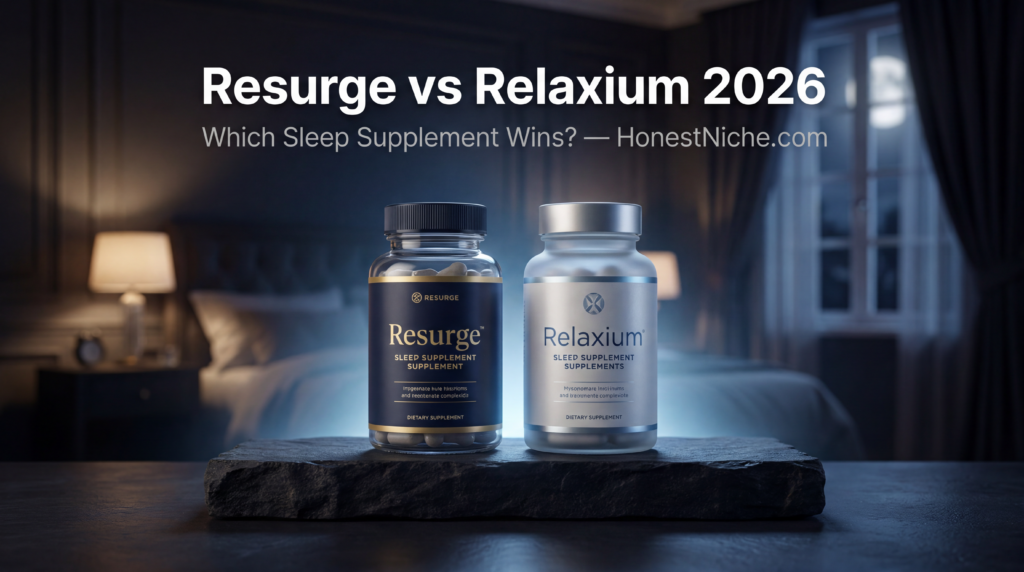
Resurge vs Relaxium is one of the most common sleep supplement comparisons I am asked about — and it makes sense why. Both products are widely advertised, both target adults with sleep difficulties, and both sit at accessible price points. But they are fundamentally different supplements targeting different sleep problems through different mechanisms. Choosing the wrong one for your situation means spending money on a formula that was never designed to solve what you are dealing with. This comparison breaks down exactly how they differ, who each one is built for, and which is the better buy depending on your specific sleep issue.
Resurge vs Relaxium 2026: Quick Comparison
| Feature | Resurge | Relaxium Sleep |
|---|---|---|
| Price | $49.00 (30-day supply) | $28.99 (30-day supply) |
| Primary mechanism | Deep sleep and metabolic recovery | Sleep onset via melatonin |
| Key ingredients | Ashwagandha, L-theanine, Melatonin, Hydroxytryptophan, Magnesium, Zinc, Lysine, Arginine | Melatonin 5mg, Magnesium Glycinate, Ashwagandha, Valerest |
| Melatonin dose | Low dose | 5mg |
| Best for | Deep sleep quality, overnight recovery, stress-related poor sleep | Sleep onset difficulty, falling asleep faster |
| Habit forming | Non-habit forming | Non-habit forming |
| Where to buy | Official website only | Amazon |
| Money back guarantee | 60 days | 30 days (Amazon returns) |
→ Check Resurge Price — Official Site
→ Check Relaxium Price on Amazon
Resurge vs Relaxium: The Fundamental Difference
Before comparing ingredients or price, it is important to understand that Resurge and Relaxium are solving different problems. This is the most important thing to grasp before spending money on either.
Relaxium Sleep leads with melatonin at 5mg. Its primary goal is to help you fall asleep faster — sleep onset. If your main complaint is lying awake for 30, 45, or 60 minutes waiting for sleep to arrive, Relaxium’s melatonin-led formula is directly targeted at that problem.
Resurge is built around a different premise entirely. It targets deep sleep — specifically the slow-wave sleep stages where the body does its most significant physical and hormonal recovery work. Resurge’s formula is designed to deepen sleep quality and support overnight metabolic recovery, not just accelerate how quickly you fall asleep. If you fall asleep without much difficulty but wake feeling unrefreshed, unrested, or physically drained despite a full night’s sleep, Resurge is addressing that problem while Relaxium is not.
Understanding this distinction determines which product is right for you before you read another word of this comparison.
Resurge vs Relaxium Ingredients: Which Formula Is Stronger?
Resurge Ingredients: What Is Actually In It?
Resurge contains a multi-compound formula built around deep sleep support and overnight recovery. The key ingredients include ashwagandha for cortisol reduction and stress-related sleep disruption, L-theanine for promoting alpha brain wave activity and mental relaxation without sedation, hydroxytryptophan (5-HTP) as a direct serotonin precursor that supports both mood and sleep architecture, magnesium for GABA receptor activation and muscle relaxation, zinc and lysine for overnight growth hormone support, and a low-dose melatonin to assist sleep onset without the next-day grogginess associated with higher doses.
The formula is designed to work on multiple sleep pathways simultaneously — stress reduction, neurotransmitter support, and hormonal recovery — rather than relying on one primary mechanism. This broader approach is what makes Resurge better suited to complex sleep problems rather than straightforward sleep onset difficulty.
Relaxium Sleep Ingredients: What Is Actually In the Formula?
Relaxium leads with melatonin 5mg — significantly higher than Resurge’s dose — alongside magnesium glycinate, ashwagandha, and its proprietary Valerest blend of valerian root and passionflower. The formula is straightforward and targeted: the high-dose melatonin drives fast sleep onset, the supporting herbs add mild sedative and anxiolytic effects, and the magnesium glycinate provides absorption-efficient mineral support.
Where Relaxium is simpler and more direct than Resurge, it also covers less ground. The absence of 5-HTP and L-theanine means it does not address serotonin pathways or alpha brain wave promotion the way Resurge does. For the specific problem of lying awake at night this does not matter — melatonin and herbal sedatives do the job effectively. For deep sleep quality and overnight recovery, the formula does not reach far enough.
Resurge vs Relaxium Ingredients: Which Formula Wins?
Resurge has the more comprehensive and scientifically layered formula. Relaxium has the more targeted formula for its specific use case. Neither is objectively better — Relaxium’s formula is exactly right for sleep onset difficulty and overcomplicated for that purpose would add cost without benefit. Resurge’s formula is exactly right for deep sleep and recovery and would be overpowered for someone who simply needs to fall asleep faster.
Resurge vs Relaxium Side Effects: What to Expect
The most commonly reported side effect from Relaxium Sleep is morning grogginess — a direct consequence of the 5mg melatonin dose which sits at the higher end of the effective range. Adults sensitive to melatonin experience next-day drowsiness more frequently at this dose than at the lower doses used by Resurge. Vivid dreams are also reported by a meaningful proportion of Relaxium users, which is a known melatonin effect.
Resurge’s lower melatonin dose and the inclusion of L-theanine — which promotes relaxed alertness rather than sedation — means the morning grogginess profile is generally more favourable. The most commonly reported Resurge side effect is mild digestive discomfort in the first week as the body adjusts to the supplement stack, which typically resolves with consistent use.
Both products are non-habit forming. Neither carries dependency risk with regular use, which is one of the meaningful advantages both hold over antihistamine-based OTC sleep aids like ZzzQuil or Benadryl.
Resurge vs Relaxium Price: Is the Cost Difference Justified?
Relaxium Sleep costs $28.99 for a 30-day supply on Amazon. Resurge costs $49.00 for a 30-day supply on the official website. Resurge is $20 more per month — a 69% price premium.
Whether that premium is justified depends entirely on which product is solving your problem. If your problem is sleep onset — falling asleep — Relaxium at $28.99 does exactly what you need and paying $20 more for Resurge’s additional formula complexity adds cost without matching benefit. If your problem is sleep quality, deep sleep, or overnight recovery — waking up exhausted despite a full night — Resurge’s formula addresses what Relaxium’s does not and the premium is justified.
The return policies also differ meaningfully. Resurge offers a 60-day money back guarantee through the official website. Relaxium has Amazon’s standard 30-day return window. For a supplement that takes 2-4 weeks to show its full effects, Resurge’s 60-day guarantee gives you a more realistic evaluation window.
Resurge vs Relaxium: Which Is Better for Insomnia?
For sleep onset insomnia — difficulty falling asleep — Relaxium’s melatonin-led formula is the more direct treatment. The 5mg melatonin produces effects within 30-60 minutes and the supporting herbs add mild sedative reinforcement. It is a well-designed formula for this specific presentation of insomnia.
For sleep maintenance insomnia — waking repeatedly during the night — neither product is primarily designed for this but Resurge’s deeper formula addressing sleep architecture is more relevant than Relaxium’s onset-focused approach.
For sleep quality insomnia — sleeping a full night but waking unrefreshed — Resurge is the more appropriate choice. Relaxium does not address the deep sleep stage quality that determines whether you wake feeling recovered.
For stress-related insomnia — where an overactive mind or elevated cortisol is the primary driver — both products include ashwagandha, but Resurge’s L-theanine and 5-HTP add additional neurological support that Relaxium’s formula does not provide.
Who Should Buy Resurge
Resurge is the right choice if your primary sleep complaint is poor sleep quality, waking unrefreshed, or feeling physically drained despite sleeping a full night. It is also the stronger choice for adults whose sleep problems are driven by chronic stress, elevated cortisol, or an overactive nervous system that disrupts sleep architecture rather than just sleep onset. The 60-day money back guarantee makes it a lower-risk investment than the price alone suggests — if it does not deliver meaningful improvement within two months you have a full refund available.
→ Try Resurge — 60-Day Money Back Guarantee
Who Should Buy Relaxium Sleep
Relaxium Sleep is the right choice if your primary problem is lying awake at night unable to fall asleep — sleep onset difficulty specifically. At $28.99 with Amazon’s free returns it is the lowest-risk entry point for adults new to sleep supplements. The melatonin-led formula is direct, accessible, and well-reviewed across 28,100 Amazon ratings. If you fall asleep easily but struggle with sleep quality, look at Resurge instead.
→ Buy Relaxium Sleep on Amazon — $28.99
Resurge vs Relaxium 2026: The Honest Verdict
There is no universally better product between these two — there is only the better product for your specific sleep problem. Relaxium Sleep is the better buy if you struggle to fall asleep. Resurge is the better buy if you struggle with sleep quality, deep sleep, or waking unrefreshed. Buying the wrong one — Relaxium when your problem is sleep quality, or Resurge when your problem is simply falling asleep — means spending money on a formula that was never designed to help you.
Identify your primary sleep complaint first. If it is sleep onset — Relaxium at $28.99 is your starting point. If it is sleep quality or recovery — Resurge at $49.00 with a 60-day guarantee is the more appropriate investment.
For a broader comparison of sleep supplements across all categories, our guide to the 7 best sleep supplements in 2026 covers the full landscape including both products reviewed here alongside alternatives like Renew and YU SLEEP.
Resurge vs Relaxium: Frequently Asked Questions
Is Resurge or Relaxium better for sleep?
It depends entirely on your sleep problem. Relaxium Sleep is better for sleep onset difficulty — lying awake unable to fall asleep. Resurge is better for sleep quality issues — falling asleep without difficulty but waking unrefreshed or feeling unrecovered. Identifying which problem you have is the most important step before buying either supplement.
Can I take Resurge and Relaxium together?
Both products contain melatonin and ashwagandha — taking them together would result in double-dosing on both compounds, which is not recommended. The melatonin overlap in particular could cause significant next-day grogginess. Choose one based on your primary sleep complaint rather than combining them.
Which is cheaper — Resurge or Relaxium?
Relaxium Sleep is cheaper at $28.99 per month versus Resurge at $49.00 per month — a $20 difference. Relaxium is also available on Amazon with standard free returns. Resurge is sold through its official website with a 60-day money back guarantee, which provides a longer evaluation window despite the higher upfront cost.
Does Resurge actually work for deep sleep?
Resurge’s formula is built around compounds with genuine evidence for supporting sleep architecture — 5-HTP as a serotonin and melatonin precursor, L-theanine for alpha brain wave promotion, ashwagandha for cortisol reduction, and magnesium for GABA activation. The combination targets multiple mechanisms relevant to deep sleep quality. Our full Resurge review covers the ingredient evidence in detail.
Does Relaxium Sleep work for anxiety-related insomnia?
Relaxium contains ashwagandha and passionflower — both of which have some evidence for reducing anxiety — alongside the primary melatonin dose. For mild anxiety-related sleep onset difficulty it is a reasonable option. For significant anxiety driving chronic insomnia, Resurge’s additional L-theanine and 5-HTP provide more comprehensive neurological support for stress-related sleep disruption.
Which sleep supplement has fewer side effects — Resurge or Relaxium?
Resurge’s lower melatonin dose and L-theanine content generally produce a more favourable morning alertness profile than Relaxium’s 5mg melatonin dose, which is the most common cause of next-day grogginess reported in Relaxium reviews. Adults sensitive to melatonin will typically find Resurge easier to tolerate. Our full Relaxium Sleep review covers the side effect profile in more detail.
References
Langade D, et al. (2019). Efficacy and safety of ashwagandha root extract in insomnia and anxiety. Journal of Ethnopharmacology.
Hidese S, et al. (2019). Effects of L-theanine administration on stress-related symptoms and cognitive functions in healthy adults. Nutrients.
Abbasi B, et al. (2012). The effect of magnesium supplementation on primary insomnia in elderly. Journal of Research in Medical Sciences.

Dr. Rachel Monroe spent twelve years working as a sleep researcher within the NHS, contributing to clinical studies on insomnia, sleep disorders, and the efficacy of natural sleep interventions. After watching patients cycle through expensive, ineffective treatments while simpler evidence-based solutions were ignored, she left clinical practice to write independently about sleep health.
Rachel knows what it feels like to lie awake at 3am with a racing mind. During the most demanding years of her research career, chronic stress-induced insomnia became a personal battle she fought alongside her patients. That experience — trying everything from prescription medication to obscure herbal supplements — is what drives her commitment to honest, evidence-based reviewing.
At Honest Niche, Rachel reviews sleep supplements, sleep programmes, and sleep devices with the same rigour she applied in clinical settings. She analyses ingredients against published research, examines real customer outcomes, and gives a straight verdict — worth it or not worth it. She is based in London and writes independently with no brand affiliations that influence her conclusions.