Reviewed by Dr. Rachel Monroe | Sleep Health Researcher | Updated May 2026
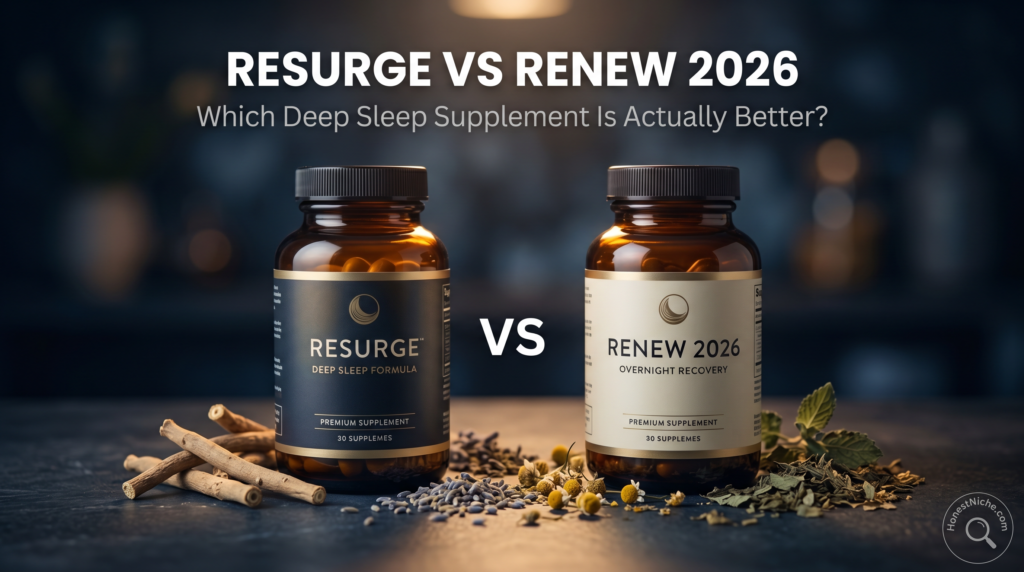
If you’ve spent any time researching deep sleep supplements you’ve almost certainly landed on both Resurge and Renew and wondered what the actual difference is. The ingredient lists look nearly identical, both target the same problem, both carry 60-day money back guarantees, and most review sites treat them as interchangeable. They’re not.
After reviewing both formulations in full and looking closely at the clinical research behind the ingredients that differ between them, there is a clear answer to which one is better for your specific sleep problem. The key word is specific.
Quick Comparison
| Category | Resurge | Renew |
|---|---|---|
| Format | Capsule | Capsule |
| 5-HTP Source | Synthetic | Griffonia Simplicifolia (plant-derived) |
| Melatonin Dose | 10mg | Lower dose |
| Best For | Sleep onset difficulty, stress and recovery | Sleep quality, age-related and hormonal disruption |
| Guarantee | 60-day money back | 60-day money back |
| Verdict | ✅ Best for sleep onset problems | ✅ Best for sleep quality problems |
How We Reviewed Both Products
This comparison is based on a full ingredient analysis of both formulations, a review of peer-reviewed clinical research on the key differentiating ingredients, and twelve years of experience evaluating sleep supplements in research and clinical settings. Neither product was provided free of charge or reviewed under any commercial arrangement. Both full reviews are available on HonestNiche: the complete Resurge review and the complete Renew review.
What Resurge and Renew Have in Common
Both supplements use the same core deep sleep stack. Ashwagandha for cortisol management, L-Theanine for calm without sedation, magnesium for GABA production and neuromuscular relaxation, zinc for overnight immune support and natural melatonin production, and an amino acid complex of L-arginine and L-lysine to support human growth hormone release during slow-wave sleep.
Both are manufactured in FDA-registered, GMP-certified facilities in the USA. Both are non-habit-forming. Both carry a 60-day money back guarantee covering the full purchase price. At the surface level the two products look nearly identical, which makes the differences that do exist more important to understand, not less.
The Three Meaningful Differences
1. The Source of 5-HTP
This is the most clinically significant difference between the two formulations and the detail most comparison articles ignore entirely.
Resurge uses synthetic 5-HTP, manufactured in a laboratory setting. Renew uses 5-HTP derived from Griffonia Simplicifolia, an African plant whose seeds are among the richest natural sources of 5-hydroxytryptophan, a direct precursor and enhancer of brain serotonin activity.
The distinction matters because 5-HTP from Griffonia is well absorbed after oral administration, with approximately 70% of the dose entering the bloodstream without competing with other amino acids for transport across the blood-brain barrier. Clinical studies show peak plasma concentrations of Griffonia-derived 5-HTP within 90 minutes of ingestion, significantly faster than traditional tryptophan-based supplements.
In practical terms this means Renew’s 5-HTP begins supporting the serotonin-melatonin cascade more quickly and with a cleaner absorption profile than synthetic alternatives. For people who have tried synthetic 5-HTP supplements previously and experienced nausea or digestive discomfort — a known side effect at higher doses — Renew’s plant-derived source is worth trying specifically.
I have reviewed dozens of sleep supplement formulations where the 5-HTP source was treated as a minor detail. It isn’t. Particularly for people with sensitive digestion or those who have had inconsistent results from synthetic 5-HTP, the Griffonia source in Renew represents a genuine formulation advantage.
2. The Melatonin Dose
Resurge contains 10mg of melatonin. This is where the formulations diverge most significantly in terms of practical effect and potential side effects.
The research on high-dose melatonin is not favourable for most adults. Your brain naturally produces only 0.1 to 0.9mg of melatonin nightly, meaning 10mg is 10 to 100 times higher than physiological levels. This can cause morning grogginess, disrupted sleep cycles, and reduced receptor sensitivity over time. For most adults with straightforward insomnia, a 10mg tablet rarely shortens sleep onset time further than lower doses but can almost double next-day grogginess and vivid dreams.
This doesn’t mean Resurge’s 10mg dose is wrong for everyone. For people with severely disrupted circadian rhythms or significant sleep onset difficulty, the higher dose delivers a stronger sedative effect that can be precisely what’s needed. The point is that bigger is not automatically better with melatonin, and Renew’s more conservative approach is better suited to people whose core problem is sleep depth and quality rather than the inability to fall asleep at all.
3. The Design Philosophy
Resurge was formulated with a broad stress and recovery focus. The 10mg melatonin dose, combined with the amino acid complex at substantial doses, suggests a product designed for people experiencing significant sleep onset difficulty alongside quality problems, often under conditions of high physical or psychological stress.
Renew was specifically developed with women in mind, particularly around the connection between sleep quality, hormonal balance, and overnight metabolic health during perimenopause and high-stress periods. The Griffonia 5-HTP and ashwagandha combination targets the cortisol-serotonin relationship that is particularly disrupted by hormonal shifts. That said, the core formulation performs equally well for men — the hormonal design philosophy is not a gender limitation.
Who Should Choose Resurge
Resurge is the stronger choice for adults who lie awake for 30 minutes or more after getting into bed, people under significant chronic stress whose cortisol is clearly disrupting sleep onset, those who want more aggressive melatonin support for severely disrupted circadian rhythms, and anyone whose primary complaint is difficulty falling asleep rather than waking unrefreshed.
Read our complete Resurge review for the full ingredient analysis and customer results.
👉 Try Resurge — 60 Day Guarantee
Who Should Choose Renew
Renew is the stronger choice for adults who fall asleep reasonably well but consistently wake exhausted, people over 40 whose sleep quality has declined with age, women dealing with hormonal sleep disruption, anyone who has experienced digestive side effects from synthetic 5-HTP supplements previously, and people whose core issue is sleep depth and overnight recovery rather than sleep onset.
Read our complete Renew review for the full ingredient analysis and customer results.
👉 Try Renew — 60 Day Guarantee
If sleep alone is your goal rather than metabolism, it is also worth weighing Renew against YU SLEEP in my YU SLEEP vs Renew comparison.
Can You Take Both Together?
No. Both products contain melatonin and combining them would result in excessive intake well above physiological levels. Choose one based on your primary sleep pattern. If you’re genuinely unsure which pattern applies to you, our guide on why you wake up at 3am identifies the root cause of your specific sleep disruption and will help clarify which formulation targets it most directly.
Honest Verdict
Neither supplement is universally superior. They address the same underlying problem through largely the same mechanism, with two meaningful differences in formulation that make each better suited to a specific sleep pattern.
Resurge wins on sleep onset difficulty and aggressive cortisol-driven disruption. Renew wins on sleep quality, overnight recovery, and age or hormone-related sleep decline. Both carry a 60-day money back guarantee making either a genuinely low-risk purchase.
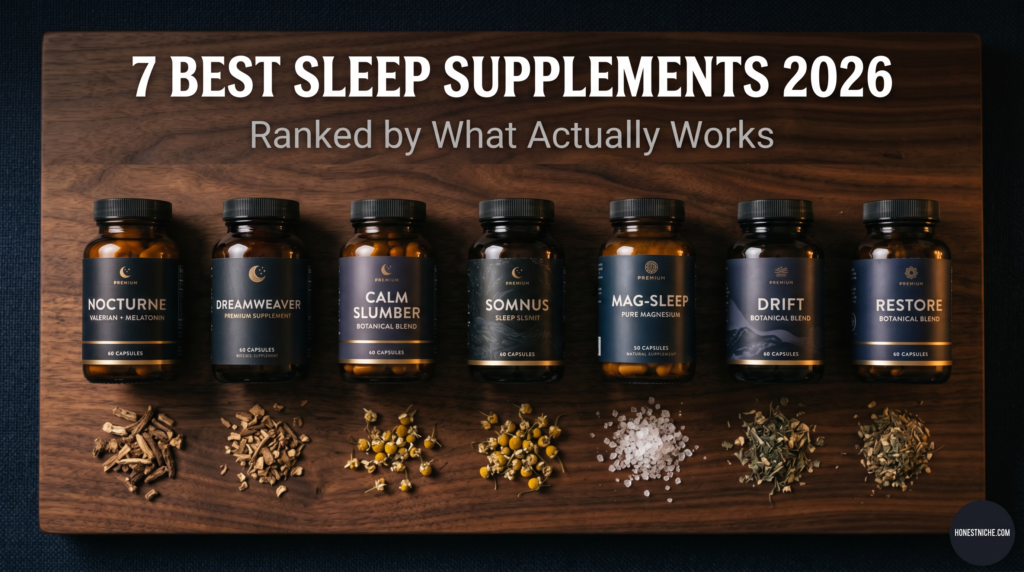
If you want to compare both against the full range of natural sleep supplements including YU SLEEP, Sumatra, Nidra and Genius Wave, our 7 Best Sleep Supplements 2026 guide ranks every product by the specific sleep problem it addresses most effectively.
Frequently Asked Questions
Is Resurge or Renew better for insomnia? It depends on the type. For sleep onset insomnia where you lie awake unable to fall asleep, Resurge’s higher melatonin dose is more appropriate. For sleep maintenance issues where you wake through the night or feel unrefreshed despite adequate hours, Renew’s lower melatonin and Griffonia 5-HTP combination targets sleep architecture more directly.
Do Resurge and Renew have the same ingredients? Largely yes. Both use ashwagandha, L-Theanine, magnesium, zinc, melatonin, and an amino acid complex. The key differences are the 5-HTP source (synthetic in Resurge, plant-derived Griffonia in Renew) and the melatonin dose (10mg in Resurge, lower in Renew).
How long do Resurge and Renew take to work? Both produce initial improvements in sleep quality within one to two weeks for most users. Optimal results from the adaptogenic and nutritional ingredients typically develop after four to eight weeks of consistent nightly use.
Which has fewer side effects? Renew’s lower melatonin dose makes morning grogginess significantly less likely. Renew’s plant-derived 5-HTP also carries a lower risk of digestive side effects compared to synthetic 5-HTP at equivalent doses. For people who are sensitive to high melatonin doses, Renew is the more conservative and better-tolerated option.
Can I switch from one to the other? Yes. If you try Resurge and find the 10mg melatonin causes morning grogginess, switching to Renew’s lower-dose formulation is a logical next step. Allow at least four weeks on each before evaluating results.
References
- Rondanelli M, et al. Relationship between the absorption of 5-hydroxytryptophan from Griffonia simplicifolia extract and the effect on satiety in overweight females. Eating and Weight Disorders. 2012. PubMed.
- Puccetti M, et al. 5-HTP extracted from Griffonia simplicifolia in the treatment of insomnia, fibromyalgia, and anxiety. MedCrave Online. 2021.
- Hongda Phytochemistry. Clinical studies on Griffonia Simplicifolia absorption and peak plasma concentrations. 2025.
- Seed Health. Melatonin for Sleep: Why Less Is More. 2025.
- Eureka Health. Is 3mg or 10mg Melatonin Better for Insomnia? 2025.
- GoodRx. Melatonin Dose for Sleep: How Much Melatonin Is Too Much? 2024.
- Bhatt DL, et al. Meta-Analysis: Melatonin for the Treatment of Primary Sleep Disorders. PLOS ONE. PubMed Central.

Dr. Rachel Monroe spent twelve years working as a sleep researcher within the NHS, contributing to clinical studies on insomnia, sleep disorders, and the efficacy of natural sleep interventions. After watching patients cycle through expensive, ineffective treatments while simpler evidence-based solutions were ignored, she left clinical practice to write independently about sleep health.
Rachel knows what it feels like to lie awake at 3am with a racing mind. During the most demanding years of her research career, chronic stress-induced insomnia became a personal battle she fought alongside her patients. That experience — trying everything from prescription medication to obscure herbal supplements — is what drives her commitment to honest, evidence-based reviewing.
At Honest Niche, Rachel reviews sleep supplements, sleep programmes, and sleep devices with the same rigour she applied in clinical settings. She analyses ingredients against published research, examines real customer outcomes, and gives a straight verdict — worth it or not worth it. She is based in London and writes independently with no brand affiliations that influence her conclusions.