Reviewed by Dr. Rachel Monroe | Sleep Health Researcher | Updated May 2026
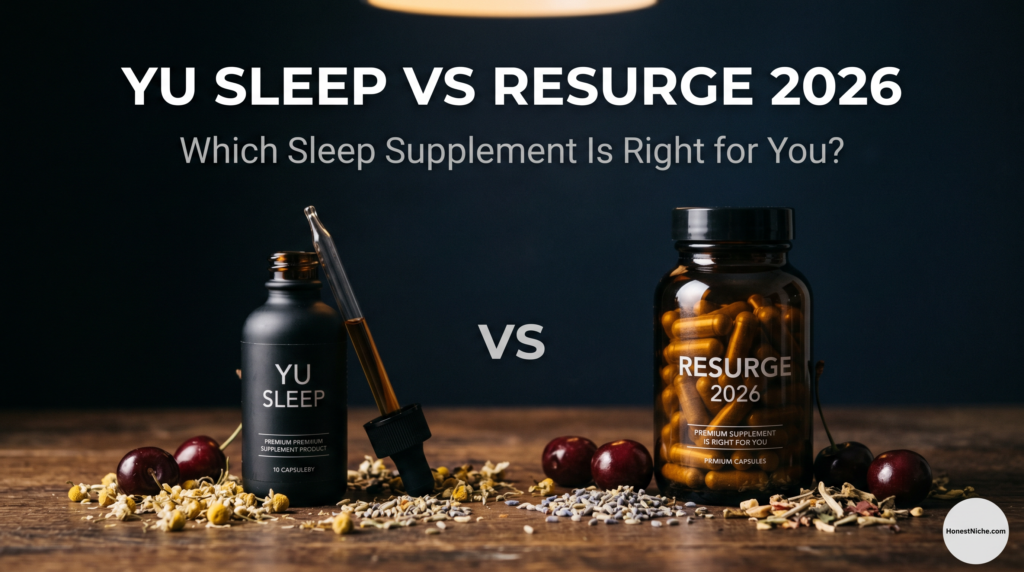
Both YU SLEEP and Resurge are among the highest-performing sleep supplements on the market in 2026 — but they work through fundamentally different mechanisms and are designed for different types of sleepers. Choosing the wrong one for your specific sleep pattern is the most common mistake people make when investing in sleep supplementation, and it’s the main reason people conclude that supplements don’t work when the product simply wasn’t matched to their problem.
This is my direct head-to-head comparison after reviewing both formulations in full.
Quick Comparison
| Category | YU SLEEP | Resurge |
|---|---|---|
| Format | Liquid drops (sublingual) | Capsule |
| Melatonin Dose | 0.9mg (micro-dose) | 10mg (high dose) |
| Key Unique Ingredients | Tart Cherry, GABA, Lemon Balm, Apigenin, B6, B2 | Ashwagandha, L-Arginine, L-Lysine, Zinc |
| Absorption Speed | Minutes (nano-enhanced sublingual) | 30-45 minutes (standard capsule) |
| Best For | Racing mind, sleep onset, anxiety-driven insomnia | Deep sleep quality, overnight recovery, cortisol |
| Guarantee | 60-day money back | 60-day money back |
| Verdict | ✅ Best for falling asleep | ✅ Best for staying asleep and recovery |
How We Reviewed Both Products
This comparison is based on a full ingredient analysis of both formulations, a review of peer-reviewed clinical research on the differentiating ingredients, and over twelve years of experience evaluating sleep supplements in research and clinical settings. Neither product was provided free of charge or reviewed under any commercial arrangement. Full individual reviews are available on HonestNiche: the complete YU SLEEP review and the complete Resurge review.
What They Have in Common
Both YU SLEEP and Resurge share the same foundational sleep stack. Both contain L-Theanine for nervous system calming, 5-HTP to support the serotonin-melatonin cascade, magnesium for GABA production and muscle relaxation, and melatonin to signal sleep onset. Both are manufactured in FDA-registered, GMP-certified facilities in the USA, both are non-habit-forming, and both carry a 60-day money back guarantee.
The similarity ends there. The formulation philosophies behind these two products are fundamentally different and target different sleep problems with different timing and mechanisms.
The Four Meaningful Differences
1. Format and Absorption Speed
YU SLEEP uses advanced nano-technology for near-complete sublingual absorption — you place the drops under your tongue and they enter your system within minutes rather than the 30 to 45 minutes standard capsules require to digest. For people who struggle with sleep onset — lying awake with thoughts racing while the supplement slowly works through digestion — this speed difference is genuinely meaningful. The calming ingredients begin working almost immediately rather than requiring pre-planning.
Resurge uses standard capsule delivery. For people taking it consistently every night at the same time this distinction matters less. For people whose anxiety or stress levels are unpredictable evening to evening, YU SLEEP’s on-demand fast delivery is a practical advantage that Resurge cannot match.
2. Melatonin Dose
YU SLEEP contains 0.9mg of melatonin. Resurge contains 10mg. This is not a minor variation — it represents fundamentally different philosophies about how melatonin should function in a sleep supplement.
Your brain naturally produces only 0.1 to 0.9mg of melatonin nightly, meaning 10mg is 10 to 100 times higher than physiological levels — capable of causing morning grogginess, disrupted sleep cycles, and reduced receptor sensitivity over time. YU SLEEP’s 0.9mg dose mirrors the body’s natural production exactly, acting as a precise timing cue rather than a sedative.
I have reviewed patients who came to me convinced that melatonin simply did not work for them. In almost every case, they had been taking doses between 5 and 10mg. When they switched to a micro-dose product their response was immediate and positive — not because the melatonin was more powerful, but because it was working with their biology rather than overwhelming it. YU SLEEP’s 0.9mg approach is clinically the more defensible position. Resurge’s 10mg is appropriate for people with severely disrupted circadian rhythms who genuinely need aggressive intervention short-term, but it carries real grogginess risk for sensitive individuals.
3. Unique Ingredients Reveal the Design Intent
The ingredients each product adds beyond the shared stack make the target audience unmistakably clear.
YU SLEEP is formulated with tart cherry juice concentrate, lemon balm extract, apigenin, Vitamin B6, and Vitamin B2 alongside the core stack. Lemon balm extract specifically reduces the cortisol spike that wakes people in the middle of the night, while GABA and L-Theanine calm overactive brain activity so the mind can actually relax at bedtime. Apigenin — a natural flavonoid found in chamomile — binds to GABA receptors and produces a gentle sedative effect without the tolerance issues associated with pharmaceutical GABA modulators. This combination was built for one type of person: someone whose brain will not stop at bedtime.
Resurge adds ashwagandha for chronic cortisol reduction, plus L-arginine and L-lysine at therapeutic doses to support human growth hormone release during deep sleep. This combination was built for a completely different type of person: someone who gets to sleep but whose body is not recovering properly during the night.
4. Cortisol Management — Acute vs Chronic
Both products address cortisol but through mechanisms operating on completely different timescales.
YU SLEEP’s lemon balm and GABA manage cortisol acutely at bedtime — calming the evening spike that makes it difficult to transition into sleep. This works immediately and is particularly effective for people dealing with situational work stress, performance anxiety, or the kind of evening mental activation that modern screen use produces.
Resurge’s ashwagandha manages cortisol chronically — reducing baseline levels over weeks of consistent use through adaptogenic mechanisms. This is a deeper, slower intervention that builds a more durable physiological change. For people under genuinely chronic long-term stress whose HPA axis has become dysregulated, ashwagandha’s adaptogenic effect is the more complete solution — even though it takes longer to manifest.
Understanding which type of cortisol problem you have is the key to choosing correctly. Our guide on why you wake up at 3am explains the biology of cortisol-driven sleep disruption in detail and will help you identify your pattern.
What Happens If You Choose the Wrong One
This section matters more than most comparison articles acknowledge.
If you choose Resurge when your actual problem is sleep onset anxiety, the 10mg melatonin may help you fall asleep but the formulation doesn’t address the overactive mind driving your problem. You may find the supplement somewhat helpful but feel it isn’t fully solving the issue. The ashwagandha will gradually lower your baseline cortisol over weeks which will help indirectly — but you’ll be waiting longer for results than necessary.
If you choose YU SLEEP when your actual problem is sleep quality and overnight recovery, the micro-dose melatonin and calming ingredients will produce a gentle relaxing effect but you’ll be missing the deep recovery support — the amino acid complex and higher melatonin dose — that your body actually needs. You may sleep but still feel unrefreshed, and correctly conclude the product isn’t for you, when the actual issue is the mismatch.
Both products carry a 60-day money back guarantee which removes the financial risk of trying the wrong one. But matching correctly from the start saves time and avoids the frustration of thinking supplements don’t work when it’s simply a product-to-problem mismatch.
Who Should Choose YU SLEEP
YU SLEEP is the stronger choice for adults who struggle to fall asleep because of racing thoughts or bedtime anxiety, people who have tried high-dose melatonin and experienced morning grogginess or diminishing returns, anyone who wants fast-acting relief within minutes rather than requiring 30-45 minutes of pre-planning, people dealing with situational or work-related evening stress, and those who prefer a liquid format.
Read our complete YU SLEEP review for the full ingredient breakdown and customer results.
👉 Try YU SLEEP — 60 Day Guarantee
Who Should Choose Resurge
Resurge is the stronger choice for adults who fall asleep eventually but consistently wake exhausted, people whose sleep quality has declined with age or under chronic long-term stress, anyone wanting stronger overnight physical recovery support from the amino acid complex, those who have tried basic melatonin at low doses without meaningful results, and people whose core complaint is sleep depth rather than sleep onset difficulty.
Read our complete Resurge review for the full ingredient breakdown and customer results.
👉 Try Resurge — 60 Day Guarantee
Can You Take Both Together?
No. Both products contain melatonin and combining them would result in excessive intake well above physiological levels. Choose one based on your primary sleep pattern. If you are genuinely uncertain which pattern applies to you, our guide on how much sleep you actually need and why you wake up at 3am will help identify your root cause before you invest.
Honest Verdict
YU SLEEP and Resurge solve different problems with different mechanisms and neither is universally superior.
YU SLEEP wins on sleep onset, fast-acting calming, physiological micro-dose melatonin, and anxiety-driven insomnia. Resurge wins on deep sleep quality, overnight physical recovery, chronic cortisol management, and age-related sleep decline.
The 60-day money back guarantee on both removes the financial risk from the decision. Match the product to your pattern, give it four consistent weeks, and judge results from there.
For a full comparison of both products against the complete range of natural sleep supplements including Renew, Sumatra, Nidra and Genius Wave, our 7 Best Sleep Supplements 2026 guide ranks every product by the specific sleep problem it addresses most effectively.
Frequently Asked Questions
Is YU SLEEP or Resurge better for insomnia? It depends on the type. For sleep onset insomnia — lying awake unable to fall asleep — YU SLEEP’s fast-acting liquid delivery and GABA-calming approach is more appropriate. For sleep maintenance insomnia — falling asleep but waking exhausted — Resurge’s deep sleep recovery focus addresses the root cause more directly.
What is the main difference between YU SLEEP and Resurge? The most significant differences are format — YU SLEEP is a fast-acting nano-enhanced liquid, Resurge is a standard capsule — and melatonin dose — YU SLEEP uses a physiological 0.9mg micro-dose, Resurge uses a high 10mg dose. These differences make each product better suited to a distinct sleep problem.
Does YU SLEEP work faster than Resurge? Yes. YU SLEEP’s nano-technology delivers ingredients sublingually for near-immediate absorption compared to the 30 to 45 minutes standard capsules require. For acute sleep onset support this is a meaningful practical advantage.
Which has fewer side effects? YU SLEEP’s 0.9mg melatonin dose makes morning grogginess significantly less likely than Resurge’s 10mg dose. People who have previously experienced morning fog or vivid dreams from high-dose melatonin will generally find YU SLEEP better tolerated.
How long do both take to show results? Most YU SLEEP users report improved sleep within 3 to 5 days, with optimal results after 4 to 6 weeks of consistent nightly use. Resurge’s adaptogenic ashwagandha ingredient shows meaningful results after 2 to 4 weeks, with deeper chronic cortisol benefits developing over 6 to 8 weeks.
Can I switch from Resurge to YU SLEEP? Yes. If you are using Resurge and finding the 10mg melatonin causing morning grogginess, switching to YU SLEEP’s micro-dose formulation is the logical next step. Allow at least 4 weeks on each before drawing conclusions.
References
- Seed Health. Melatonin for Sleep: Why Less Is More. 2025.
- Manila Times. YuSleep Claims Evaluated — Nano-Enhanced Formula and Ingredient Overview. May 2026.
- Sleep Essentials Hub. Yu Sleep Review 2026 — Ingredient and Formulation Analysis. 2025.
- Yahoo Finance. Yu Sleep Unveiled — Neurochemical Mechanisms and Delivery Technology. 2025.

Dr. Rachel Monroe spent twelve years working as a sleep researcher within the NHS, contributing to clinical studies on insomnia, sleep disorders, and the efficacy of natural sleep interventions. After watching patients cycle through expensive, ineffective treatments while simpler evidence-based solutions were ignored, she left clinical practice to write independently about sleep health.
Rachel knows what it feels like to lie awake at 3am with a racing mind. During the most demanding years of her research career, chronic stress-induced insomnia became a personal battle she fought alongside her patients. That experience — trying everything from prescription medication to obscure herbal supplements — is what drives her commitment to honest, evidence-based reviewing.
At Honest Niche, Rachel reviews sleep supplements, sleep programmes, and sleep devices with the same rigour she applied in clinical settings. She analyses ingredients against published research, examines real customer outcomes, and gives a straight verdict — worth it or not worth it. She is based in London and writes independently with no brand affiliations that influence her conclusions.